
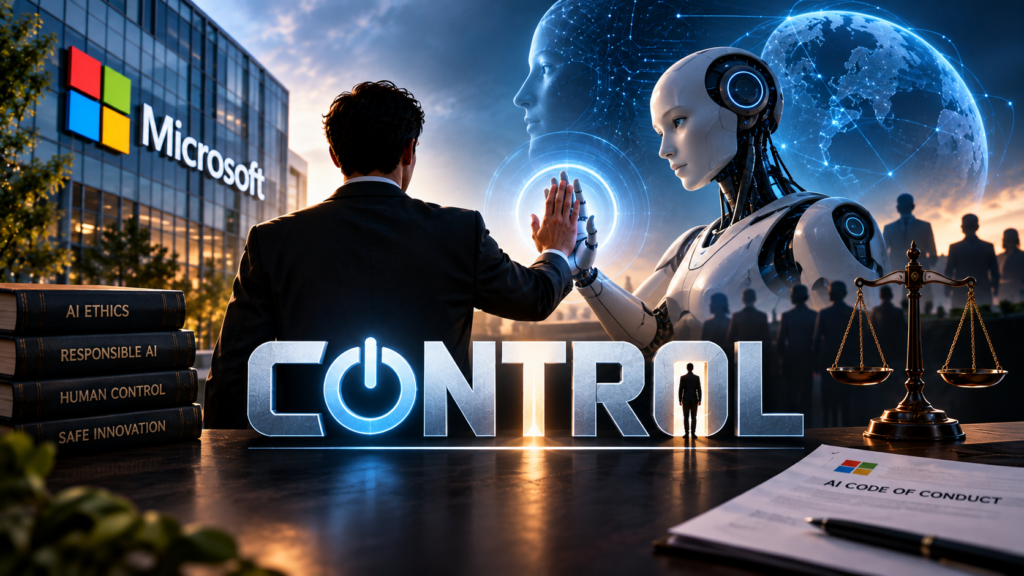
Addressing Safety Fears Through Structured Governance
As the artificial intelligence landscape accelerates at an unprecedented pace, major technology firms are facing intensifying scrutiny regarding safety, alignment, and long-term control. In response to these growing industry-wide concerns, Microsoft has published a formal AI code of conduct. The framework has been framed as an urgent initiative designed to establish strict operational boundaries for current and future AI models, ensuring that human oversight remains central to technological advancement.
According to reports, Microsoft AI CEO Mustafa Suleyman spearheaded the release of the code, emphasizing the immediate necessity of establishing standardized guidelines. The core objective of the initiative is to maintain continuous human command over all advanced systems, mitigating risks associated with autonomous decision-making and unexpected behavioral scaling.
Key Pillars of the Microsoft AI Code of Conduct
While the detailed text encompasses a broad spectrum of ethical and operational directives, the primary focus centers on transparency, accountability, and containment. Industry analysts have pointed out that as frontier models grow more capable, the gap between human intent and machine execution risks widening if proactive governance measures are absent.
- Human-in-the-Loop Mandates: Ensuring that pivotal decisions and system outputs retain mandatory human authorization gates.
- Operational Transparency: Creating clearer frameworks for auditing how models process data and derive outputs.
- Safety Thresholds: Defining explicit performance and safety boundaries that models must not cross during training or deployment.
- Urgent Industry Alignment: Urging broader collaboration across the technology sector to prevent a fragmented approach to safety standards.
The Broader Industry Context and Geopolitical Pressures
Microsoft’s proactive stance arrives at a complex juncture for the global technology market. Concurrently, other major enterprise players are navigating the steep financial realities of the AI boom, balancing aggressive infrastructure spending with internal restructuring and workforce adjustments. Furthermore, international perspectives on AI governance continue to diverge. Reports indicate that global bodies and foreign entities—including counterparts in China—maintain distinct philosophies regarding regulatory oversight and the pace of innovation, complicating efforts to establish universal international standards.
By articulating a definitive internal code of conduct, Microsoft aims to position itself as a steward of responsible AI development. However, analysts note that the ultimate efficacy of such codes depends heavily on enforcement mechanisms and how transparently companies evaluate their own foundational models.
Looking Ahead: Accountability in Practice
The introduction of Microsoft’s code of conduct underscores a shifting paradigm within the tech sector, where proactive safety commitments are increasingly utilized to build public and regulatory trust. As these guidelines move from drafting tables into active deployment across research and engineering teams, the industry will be watching closely to see how effectively corporate governance can keep pace with rapid machine learning breakthroughs.