
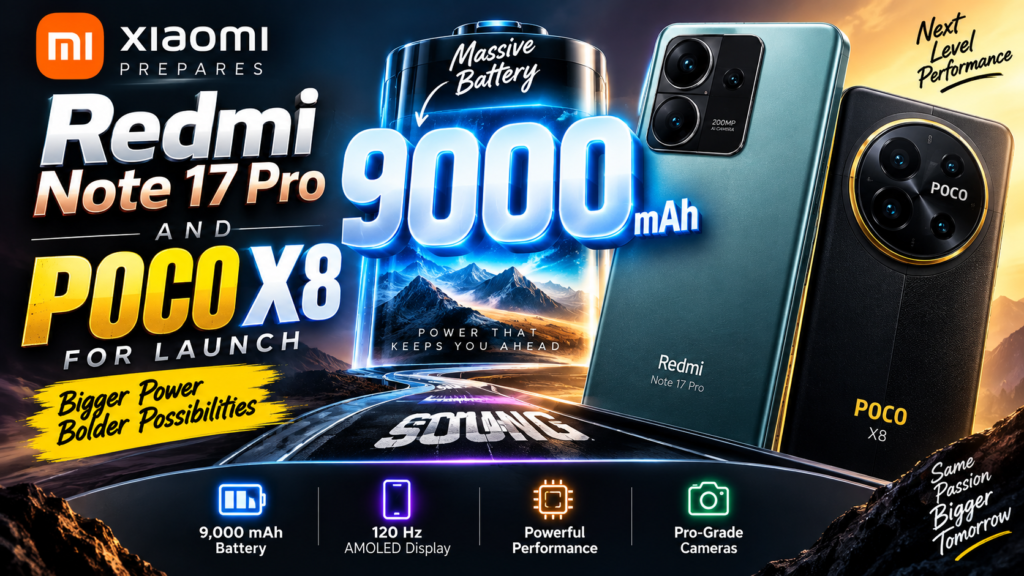
Xiaomi is gearing up for a significant mid-range expansion following the appearance of two upcoming handsets—the Redmi Note 17 Pro and the POCO X8—in the official certification directory of Brazil’s telecommunications agency, Anatel. The regulatory milestone indicates that both smartphones are approaching an imminent commercial debut in Latin America. According to the regulatory findings, the upcoming duo introduces a compelling balance of high-end display hardware and robust internals, headlined by a standout variant equipped with a battery capacity reaching up to 9,000 mAh, alongside 120 Hz AMOLED panels, Qualcomm’s Snapdragon 6s Gen 4 platform, and 67W rapid wired charging.
Regulatory Filings Signal Imminent Launch
Telecommunications compliance databases are consistently among the most reliable indicators of near-term smartphone launches. Before an OEM can legally distribute and market cellular hardware within a sovereign jurisdiction, devices must complete rigorous RF compliance, electrical safety, and network interoperability evaluations. In Brazil, that regulatory responsibility falls under the National Telecommunications Agency (Agência Nacional de Telecomunicações, or Anatel).
The appearance of the Redmi Note 17 Pro and the POCO X8 in the Anatel directory demonstrates that both devices have crossed the formal compliance hurdles necessary for sale. While Xiaomi has not yet attached exact calendar launch dates or public pricing tiers to either device, formal regulatory clearance typically occurs in the final weeks leading up to official regional commercialization. The dual appearance under both the Redmi Note and POCO banners also reflects Xiaomi’s continued strategy of dual-brand segmentation across emerging and competitive global smartphone markets.
The 9,000 mAh Battery: Redefining Mid-Range Endurance
The most eye-catching specification confirmed by the regulatory records is the presence of an enormous battery configuration scaling up to 9,000 mAh. In an era where the prevailing industry standard for modern smartphones has hovered stubbornly between 4,500 mAh and 5,000 mAh, a capacity of this scale represents a massive architectural departure from conventional battery sizing.
To contextualize what a 9,000 mAh capacity means in everyday operation:
- Multi-Day Runtime: Under standard mixed-use conditions, a typical 5,000 mAh smartphone achieves between 24 and 36 hours of moderate use. A 9,000 mAh reservoir effectively expands that runtime envelope into multi-day territory, enabling heavy workloads, extended hotspot usage, and intensive navigation without requiring daily visits to an outlet.
- Thermal and Volumetric Considerations: Packing 9,000 mAh into a consumer smartphone requires substantial engineering considerations regarding cell density, internal chassis volume, and weight management. Modern silicon-enhanced anode chemistries allow higher milliampere-hour ratings within compact physical footprints, though the handset housing this cell will inevitably carry distinct ergonomic heft compared to standard ultra-slim competitors.
- Sustained Field Performance: For users operating in regions with intermittent grid reliability or mobile workers reliant on battery preservation over long shifts, high-capacity cells serve as practical tools rather than mere marketing talking points.
Snapdragon 6s Gen 4 and 120 Hz AMOLED Display
Beyond battery metrics, the filings indicate that the new devices share a core hardware platform powered by the Snapdragon 6s Gen 4 processor paired with high-refresh-rate 120 Hz AMOLED panels. This pairing speaks directly to modern mid-range consumer expectations, where fluid visual interaction and energy-efficient processing take priority over raw, flagship-tier benchmark numbers.
Display Performance
An AMOLED panel operating at 120 Hz provides two fundamental operational advantages: deep, individual-pixel contrast and high temporal resolution. The 120 Hz refresh rate ensures that system-level animations, web scrolling, and supported mobile gaming experiences render with smooth motion and minimal input latency. Combined with the intrinsic high-contrast and power-efficient characteristics of organic light-emitting diodes—which consume zero power when rendering true blacks—the panel can maximize the efficiency gains offered by the handset’s internal cell architecture.
Processing Efficiency
The selection of the Snapdragon 6s Gen 4 positions both the Redmi Note 17 Pro and POCO X8 squarely within Qualcomm’s modern mid-tier silicon ecosystem. In this performance bracket, chip architectures are engineered to prioritize efficiency per watt rather than unthrottled burst performance. Paired with modern display drivers and low-power modem components, the chipset is well-suited to sustain daily multitasking, communication, streaming, and mainstream application usage while sipping power conservatively—a vital factor in unlocking the full potential of high-capacity hardware.
67W Fast Charging Dynamics
Power delivery remains a critical factor whenever battery capacities expand. According to the regulatory data, the hardware platform supports 67W wired fast charging. While high-wattage charging architectures have matured across the industry, deploying a 67W solution alongside an outsized battery capacity introduces distinct technical dynamics.
A standard 5,000 mAh cell paired with a 67W charger typically recharges from near empty to full within approximately 45 to 50 minutes. When applied to an oversized pack—particularly the variant reaching up to 9,000 mAh—charging dynamics adjust across the battery’s charge curve:
- Constant Current Phase: The charging system delivers maximum supported current during the lower stages of depletion (e.g., 0% to 50%), enabling rapid replenishment during short charging top-ups.
- Thermal Regulation: As the massive cell accumulates charge, onboard charge controllers taper current to control internal temperature build-up, preserving battery health and preventing thermal throttling.
- Total Cycle Times: While a full 0-to-100% cycle on an exceptionally large pack naturally takes longer than on a conventional 5,000 mAh device, 67W ensures that partial top-ups still inject hours of usable operational life in just 15 to 20 minutes.
Brand Strategy: POCO X8 and Redmi Note 17 Pro
Xiaomi has traditionally maintained a two-pronged approach with its secondary product lines. The Redmi Note series serves as the cornerstone of Xiaomi’s value-driven mid-market sales worldwide, balancing camera capabilities, reliable industrial design, and mass-market pricing. Meanwhile, the POCO X line has consistently focused on value-oriented power users, prioritizing display smoothness, sustained processing performance, and distinctive design language.
The simultaneous certification of the Redmi Note 17 Pro and the POCO X8 with closely aligned baseline specifications—including the Snapdragon 6s Gen 4, 120 Hz AMOLED screens, and 67W charging—suggests shared platform engineering between the two models. Depending on Xiaomi’s final go-to-market plan, the two models may either target distinct consumer sub-segments within Latin America or represent regional branding variations adapted for specific carrier partners and retail distribution channels.
Availability and Next Steps
With both the Redmi Note 17 Pro and POCO X8 now formally logged in the Anatel directory, regulatory barriers to entry in Brazil have been cleared. As is customary with regulatory documentation, granular commercial details such as suggested retail prices, regional bundle promotions, internal storage tiers, and exact shelf release dates have not yet been disclosed by Xiaomi. However, the completion of formal certifications signals that full commercial announcements and regional rollout schedules are now directly on the horizon.