
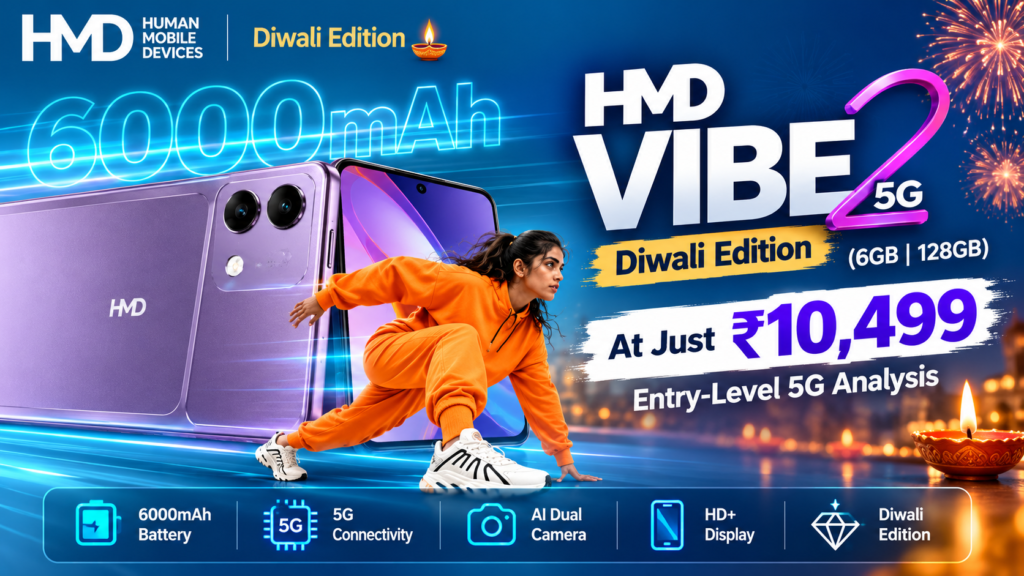
Human Mobile Devices has expanded its budget hardware lineup with the release of the HMD Vibe 2 5G Diwali Edition, arriving at a promotional price point of Rs 10,499. Positioned directly in India’s fiercely contested sub-Rs 11,000 price tier, the handset arrives as a festive-timed entry aimed at consumers seeking affordable fifth-generation network access without crossing into mid-range expenditure.
As mobile network operators in India continue expanding their standalone and non-standalone 5G footprints across tier-two and tier-three regions, hardware manufacturers have faced mounting pressure to lower the threshold of 5G ownership. The arrival of the Vibe 2 5G Diwali Edition represents HMD’s latest bid to capture value-conscious shoppers during one of the most active commercial purchasing cycles of the year.
The Sub-Rs 11,000 Landscape: Where the Vibe 2 5G Fits
Price elasticity in the Indian smartphone sector is notoriously acute around the Rs 10,000 mark. Moving from Rs 9,999 to even Rs 12,000 can drastically alter a device’s competitive set. By pricing the Diwali Edition at Rs 10,499, HMD targets a specific psychological bracket: consumers upgrading from aging 4G handsets who want future-proof network compatibility without committing to mid-tier prices of Rs 15,000 or higher.
Historically, festive special editions in the Indian market package distinct colorways, refreshed packaging, or bundled regional promotions to attract seasonal shoppers. HMD’s strategy aligns with this tradition, introducing a branded festive variant designed to stand out on retail shelves and online commerce portals during peak festival discount weeks.
The Engineering Reality of Budget 5G Hardware
Delivering 5G capabilities at Rs 10,499 involves intricate trade-offs in mobile hardware engineering. To appreciate what consumers can realistically expect from an ultra-budget 5G device, it is essential to examine the technical components that drive costs:
- Baseband Modems and RF Front-Ends: Integrating 5G connectivity requires specialized Radio Frequency (RF) front-end modules, additional antennas, and modern modem silicon capable of negotiating sub-6GHz frequency bands. Even entry-tier 5G chipsets command a higher bill of materials (BOM) cost than legacy 4G-only processors.
- Silicon Trade-Offs: Because a substantial portion of the hardware budget is dedicated to the 5G modem and licensing, manufacturers operating near Rs 10,000 must prioritize silicon efficiency over raw graphical compute power. These platforms are designed primarily for day-to-day communication, social platforms, media playback, and basic productivity rather than heavy 3D rendering.
- Display Architecture: At this price threshold, manufacturers typically utilize LCD panels rather than costlier AMOLED modules. Engineering choices often revolve around balancing standard versus high refresh rates against battery consumption limits.
- Camera Subsystems: Entry-level camera modules rely heavily on computational photography pipelines provided by the system-on-chip rather than large, physically complex camera sensors or optical image stabilization assemblies.
For buyers evaluating the HMD Vibe 2 5G Diwali Edition, recognizing these engineering constraints is vital. The inclusion of 5G at Rs 10,499 ensures fast mobile data throughput and low latency when connected to compatible base stations, but the device fundamentally remains an entry-tier daily driver rather than a multimedia powerhouse.
HMD’s Shifting Brand Identity
The introduction of the Vibe 2 5G Diwali Edition also highlights HMD’s ongoing brand transition. After several years of producing devices under the licensed Nokia banner, HMD has steadily expanded its self-branded mobile portfolio. Establishing consumer trust under the native HMD marque requires proving consistency in software stability, build durability, and after-sales support.
In the entry-level segment, brand perception often rests on practical software execution. Budget consumers frequently grapple with aggressive background process management and third-party bloatware. HMD has traditionally emphasized cleaner user interfaces and manageable software footprints. Maintaining this disciplined approach on a Rs 10,499 handset is crucial for keeping lower-tier hardware responsive over prolonged usage cycles.
Evaluating the Upgrade: Is It Worth It?
Deciding whether the HMD Vibe 2 5G Diwali Edition warrants an immediate purchase depends heavily on the device being replaced:
When the Upgrade Makes Sense
- Transitioning from 4G Hardware: Users currently operating three- to four-year-old 4G smartphones will notice marked improvements in cellular data download speeds, network capacity, and general responsiveness when shifting to a modern 5G platform.
- Carrier Plan Optimization: In regions where telecom providers offer preferential data allocations or uncapped access on 5G tiers, an accessible Rs 10,499 device allows users to capitalize on those network benefits without buying an expensive flagship.
- Secondary or Utility Device Needs: For gig workers, field employees, or users needing a dedicated work terminal with stable mobile hotspot performance, an affordable 5G handset provides practical utility at minimal capital cost.
When to Hold Off
- Existing 5G Users: If you already own an operational 5G handset—even an entry-level model from the past eighteen months—the generational gains at the Rs 10,499 price point will be modest.
- Demanding Mobile Gamers: Enthusiasts looking to play high-fidelity titles should look toward higher budget tiers where thermal dissipation hardware, dedicated cooling layers, and higher-tier GPUs are economically feasible.
Macro Pressures on Ultra-Budget 5G
The release of the Vibe 2 5G Diwali Edition comes at a critical juncture for the broader mobile supply chain. Component pricing—spanning memory modules, display glass, and packaging logistics—has experienced intermittent volatility across global markets. Sustaining a viable product at Rs 10,499 requires rigorous supply chain management.
While flagship smartphones absorb rising bill-of-materials costs through higher retail margins, sub-Rs 11,000 devices operate on razor-thin allowances. Any minor increase in silicon wafer pricing or import tariffs impacts manufacturer profitability. HMD’s ability to introduce a dedicated 5G variant at this specific price reflects competitive sourcing aimed at keeping market share against well-established budget incumbents.
Final Takeaway
The HMD Vibe 2 5G Diwali Edition stands as a pragmatic market response to India’s ongoing 5G transition. At Rs 10,499, it serves a clear demographic: budget-conscious buyers seeking an entry point into next-generation connectivity without paying the premiums associated with the mid-tier market. While prospective purchasers must maintain realistic expectations regarding overall processing headroom and camera fidelity, the device represents an accessible bridge to modern cellular infrastructure during the festive retail season.